Overview
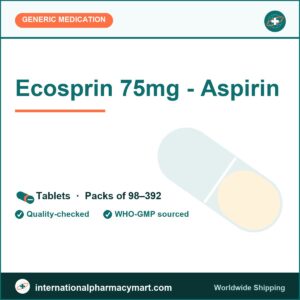
Ecosprin 150 is a tablet that contains aspirin 150mg (acetylsalicylic acid). It is made by USV Private Limited. At this low dose aspirin works as a blood thinner (antiplatelet): it stops platelets from sticking together and forming clots.
- Low-dose aspirin 150mg per tablet
- Helps prevent another heart attack or stroke
- Usual dose: 75–150mg once a day, long term
- Start only on a doctor’s advice; for adults only
Uses
According to the official product information, low-dose aspirin is used for:
- Preventing another blood clot in people with heart disease (for example after a heart attack)
- Preventing another blood clot in people with blood vessel disease of the brain (for example after a stroke caused by a clot)
- After heart bypass surgery
It is not suitable as a pain reliever, fever reducer or anti-inflammatory. See more heart disease and blood thinner medicines.
How it works
Aspirin permanently blocks an enzyme (cyclooxygenase) in platelets, so they cannot make thromboxane A2, a substance that makes platelets clump together. Because platelets cannot make new enzyme, the effect lasts for the platelet’s whole life (7–10 days). Normal clotting slowly returns 24 to 48 hours after stopping, as new platelets are made.
Dosage
Ask your doctor before you start low-dose aspirin for the first time. The official directions are:
- Usual long-term dose: 75mg to 150mg once a day — that is 1 Ecosprin 150 tablet once a day.
- Your doctor may advise up to 300mg a day for a short time.
- Take it with water and follow the directions on the pack.
- Your treatment should be reviewed regularly. Older adults are more likely to get side effects.
- Children and teenagers under 16: not for use (risk of Reye’s syndrome).
Safety warning
- Bleeding: aspirin increases the risk of bleeding, including bleeding in the stomach or gut. Get medical help right away if you vomit blood, have black or tarry stools, or have unusual bleeding.
- Do not take it if you have an active stomach ulcer or a history of repeated ulcers or stomach bleeding, a bleeding disorder (such as hemophilia or low platelets), gout, or severe liver or kidney disease.
- Do not take it if you are allergic to aspirin or other NSAIDs (for example if they have caused asthma attacks, a runny nose or hives).
- Asthma, hay fever, nasal polyps or long-term lung disease: aspirin may trigger breathing problems.
- Surgery and dental work: tell your surgeon or dentist you take aspirin.
- Skin reactions: stop it at the first sign of a rash, mouth sores or other allergic signs.
- Use with care if you have high blood pressure, heavy periods, or are dehydrated.
- Overdose can be serious, especially in older adults and children. Call Poison Control (1-800-222-1222) or 911 right away.
Side effects
Common (up to 1 in 10 people): bleeding more easily, indigestion.
Uncommon (up to 1 in 100): runny nose, shortness of breath, hives.
Rare (up to 1 in 1,000): serious stomach or gut bleeding, bleeding in the brain, nausea, vomiting, asthma attacks, allergic reactions including swelling and anaphylaxis, low blood counts, heavy periods, serious skin reactions.
Frequency not known: nosebleeds and bleeding gums, stomach ulcers, diarrhea, headache, dizziness, ringing in the ears or reduced hearing, gout (higher uric acid), liver or kidney problems, fluid retention.
Interactions
- Methotrexate above 15mg a week: do not take together. Lower doses need blood count checks.
- Blood thinners (warfarin, heparin), other antiplatelets (clopidogrel, dipyridamole) and SSRI antidepressants (sertraline, paroxetine): higher risk of bleeding.
- Other NSAIDs and steroid tablets (corticosteroids): higher risk of stomach ulcers and bleeding. Ibuprofen may reduce aspirin’s protective effect.
- Probenecid and sulfinpyrazone (gout medicines): avoid.
- Digoxin and lithium: levels may rise and need checking.
- Diuretics and blood pressure medicines (including ACE inhibitors): may work less well and raise the risk of kidney problems.
- Sulfonylureas (diabetes), valproate, phenytoin, acetazolamide, cyclosporine, tacrolimus and metamizole: ask your doctor.
- Alcohol raises the risk of stomach bleeding. Antacids can reduce aspirin’s effect.
Pregnancy & breastfeeding
Pregnancy: do not take aspirin in the first and second trimester unless your doctor says it is clearly needed. Doses above 100mg a day (including Ecosprin 150) must not be used in the last 3 months of pregnancy — they can harm the baby’s heart and kidneys and cause bleeding and a delayed labor. From week 20, aspirin can reduce the fluid around the baby.
Breastfeeding: small amounts pass into breast milk. Short-term use is not expected to harm the baby, but stop breastfeeding for long-term use or higher doses — ask your doctor.
Storage
Store below 25°C (77°F). Keep out of the sight and reach of children.
Pack sizes & prices
| Pack | Price per tablet | Pack price |
|---|---|---|
| 98 Tablets | $0.90 | $88.20 |
| 196 Tablets | $0.86 | $168.56 |
| 294 Tablets | $0.80 | $235.20 |
| 392 Tablets | $0.71 | $278.32 |
See our shipping policy for delivery times and costs, and how ordering works. Browse all medications.
FAQs
What is Ecosprin 150 used for?
It is used long term to help prevent blood clots — and so another heart attack or stroke — in people who already have heart or blood vessel disease of the heart or brain, and after heart bypass surgery.
How should I take Ecosprin 150?
Ecosprin 150 is usually taken as 1 tablet once a day. The usual long-term dose of low-dose aspirin is 75mg to 150mg once a day. Your doctor may advise a different dose. Take it with water and follow the directions on the pack.
Is it the same as US baby aspirin (81mg)?
It is the same medicine, aspirin, at a different strength. US low-dose aspirin tablets are 81mg; Ecosprin 150 has 150mg per tablet. Ask your doctor which dose is right for you.
Can I take it for a headache or fever?
No. Low-dose aspirin is not suitable as a pain, fever or anti-inflammatory medicine.
Can I take ibuprofen with it?
Ibuprofen may block the heart-protecting effect of low-dose aspirin when they are taken close together. Occasional ibuprofen is unlikely to matter; ask your doctor before regular use.
Should I stop it before surgery or dental work?
Aspirin raises the risk of bleeding during and after operations, even a tooth extraction. Tell your surgeon or dentist you take it — do not stop it on your own.
Source: Summary of Product Characteristics for low-dose aspirin 75mg tablets (emc — UK electronic medicines compendium, revised October 2026). USV does not publish a leaflet online, so always read the leaflet in your pack. This page is for information only and does not replace advice from your doctor or pharmacist.
Reviews
There are no reviews yet.