Overview
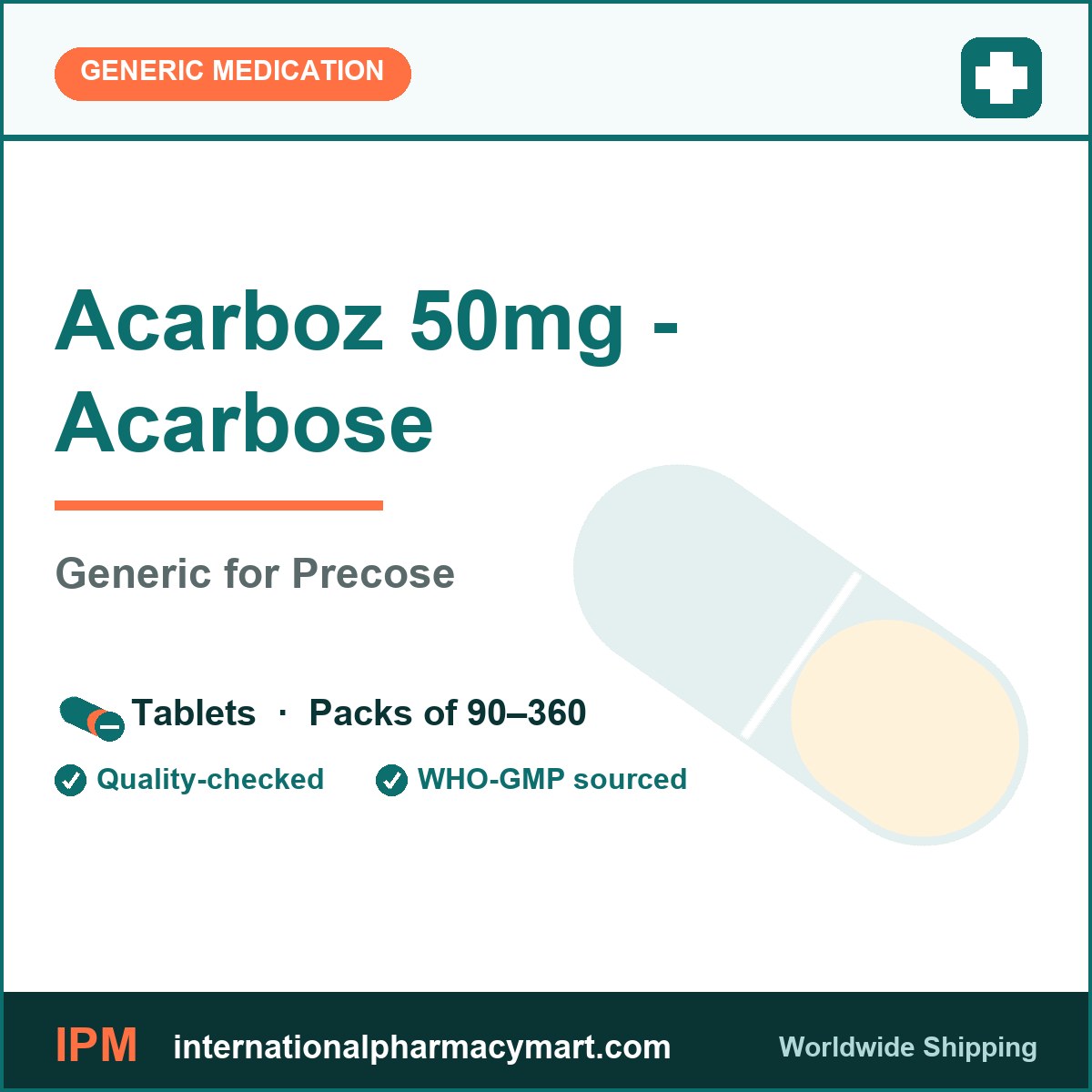
Acarboz 50mg is a tablet that contains acarbose 50mg. It is made by Knoll Pharmaceuticals Ltd and is a generic version of Precose. Acarbose is an alpha-glucosidase inhibitor used, together with diet and exercise, to improve blood sugar control in adults with type 2 diabetes.
- Acarbose 50mg per tablet
- Generic version of Precose
- Lowers the rise in blood sugar after meals
- Taken three times a day with the first bite of each main meal
Uses
According to the official label, acarbose is used as an add-on to diet and exercise to improve blood sugar (glycemic) control in adults with type 2 diabetes mellitus.
- It can be used on its own or together with a sulfonylurea, metformin or insulin; its effect adds to theirs.
- It is not approved for children — safety and effectiveness in children have not been established.
See more diabetes medicines.
How it works
Acarbose slows the digestion of carbohydrates in the gut. It blocks enzymes (pancreatic alpha-amylase and intestinal alpha-glucosidases) that break starches and sugars down into glucose. Glucose is therefore absorbed more slowly, and blood sugar rises less after meals. Over time this lowers HbA1c. Unlike sulfonylureas, acarbose does not increase insulin release. Very little of it is absorbed into the blood — it works mainly inside the digestive tract.
Dosage
Take Acarboz exactly as your doctor prescribes. The doses on the official label are:
- Starting dose: 25mg three times a day, at the start (with the first bite) of each main meal. Some people start with 25mg once a day and build up to three times a day to reduce stomach side effects.
- Adjusting: the dose may be increased every 4–8 weeks, from 25mg to 50mg three times a day, and in some people to 100mg three times a day. The usual maintenance dose is 50–100mg three times a day.
- Maximum dose: 50mg three times a day if you weigh 60 kg or less; 100mg three times a day if you weigh more than 60 kg.
- Keep following your diet, exercise plan and blood or urine sugar testing.
Safety warning
- Do not take acarbose if you have diabetic ketoacidosis, cirrhosis, inflammatory bowel disease, colon ulcers, partial bowel blockage or a risk of it, long-term bowel disease affecting digestion or absorption, conditions that get worse with more gas in the gut, or an allergy to acarbose.
- Low blood sugar: acarbose alone should not cause it, but with a sulfonylurea or insulin the risk goes up. Keep glucose (dextrose) on hand — table sugar (sucrose) will not work quickly while taking acarbose.
- Liver: raised liver enzymes can occur, especially above 50mg three times a day. Liver tests are recommended every 3 months in the first year, then from time to time. Rare serious liver problems, including fatal hepatitis, have been reported.
- Kidney problems: not recommended in people with significant kidney problems (serum creatinine above 2.0 mg/dL).
- Stress, illness or surgery can upset blood sugar control; insulin may be needed for a short time.
- Rare cases of pneumatosis cystoides intestinalis (gas cysts in the bowel wall) have been reported. Tell your doctor about diarrhea with mucus, rectal bleeding or constipation.
Side effects
Stomach and bowel symptoms are the most common side effects. In US clinical trials they were:
- Gas (flatulence) — 74%
- Diarrhea — 31%
- Stomach (abdominal) pain — 19%
They usually start in the first few weeks and tend to become less frequent and milder over time. Not following your diabetic diet can make them worse. If they are very troublesome despite the diet, see your doctor — the dose may be lowered.
Other reported effects include skin rash, hives, swelling (edema), raised liver enzymes, jaundice or hepatitis, low platelets and bowel blockage (ileus).
Interactions
- Sulfonylureas or insulin: higher risk of low blood sugar; their dose may need adjusting.
- Digoxin: acarbose can change digoxin levels; the digoxin dose may need adjusting.
- Charcoal and digestive enzyme products (such as amylase or pancreatin) can reduce the effect of acarbose and should not be taken with it.
- Medicines that can raise blood sugar — such as thiazide and other diuretics, corticosteroids, phenothiazines, thyroid medicines, estrogens, birth control pills, phenytoin, nicotinic acid, sympathomimetics, calcium channel blockers and isoniazid — may weaken blood sugar control.
Tell your doctor about all the medicines, vitamins and herbal supplements you take.
Pregnancy & breastfeeding
The safety of acarbose in pregnant women has not been established, and it should be used in pregnancy only if clearly needed; most experts recommend insulin to control blood sugar during pregnancy. It is not known whether acarbose passes into human breast milk, and the label says it should not be given to a breastfeeding woman.
Storage
Store at room temperature, 20°C to 25°C (68°F to 77°F). Protect from moisture and keep the pack tightly closed. Keep out of the reach of children.
Pack sizes & prices
| Pack | Price per tablet | Pack price |
|---|---|---|
| 90 Tablets | $0.65 | $58.50 |
| 180 Tablets | $0.61 | $109.80 |
| 270 Tablets | $0.57 | $153.90 |
| 360 Tablets | $0.51 | $183.60 |
See our shipping policy for delivery times and costs, and how ordering works. Browse all medications.
FAQs
Is Acarboz 50mg the same as Precose?
Both contain acarbose as the active ingredient. Acarboz is made by Knoll Pharmaceuticals; Precose is the original brand name.
When should I take acarbose?
Take it three times a day at the start of each main meal, with the first bite. It works on the food you eat with it.
What is the usual dose?
The usual starting dose is 25mg three times a day. Some people start with 25mg once a day and slowly increase to three times a day to reduce stomach side effects. Your doctor may raise the dose every 4 to 8 weeks, usually to 50mg three times a day — the strength of one Acarboz 50mg tablet.
Can acarbose cause low blood sugar?
Taken alone, acarbose should not cause low blood sugar. Taken with a sulfonylurea or insulin, the risk of low blood sugar goes up. Treat low blood sugar with glucose (dextrose) tablets or gel, not table sugar — acarbose blocks the breakdown of table sugar.
Why does it cause gas and diarrhea?
Acarbose slows the digestion of carbohydrates, so some undigested carbohydrate reaches the lower bowel and causes gas, diarrhea and stomach pain. These effects usually start in the first few weeks and often get less over time. Following your diabetic diet helps.
Who should not take acarbose?
People with diabetic ketoacidosis, cirrhosis, inflammatory bowel disease, colon ulcers, (risk of) bowel blockage, or long-term bowel disease affecting digestion or absorption, and anyone allergic to acarbose.
Source: FDA-approved prescribing information for acarbose tablets 25 mg, 50 mg and 100 mg (generic Precose), Strides Pharma Science Limited, on DailyMed (revised 08/2025). This page is for information only and does not replace advice from your doctor or pharmacist.
Reviews
There are no reviews yet.